



I’m a Physician with a Disability—What Can I Do to Protect Myself?
As a physician, you’re trained to solve complex problems under pressure. You have worked hard for your career, and probably never expected to have to stop working due to a disability. Perhaps you applied on your own for those benefits and the insurance carrier denied your claim, or perhaps you’re beginning the process of applying for long-term disability insurance benefits. What can cause highly educated medical professionals to lose their long-term disability appeals?
It’s not a lack of intelligence. And it’s definitely not because you’re “not really disabled.”
In my work representing physicians and other high-income professionals, I’ve seen a frustrating pattern: doctors who rightfully file for disability benefits are denied just as frequently (and sometimes more so) as people who are not trained in medicine.
Here’s what’s going wrong, and how you can protect your livelihood and your future.
- Doctors are often treated on an informal basis by their colleagues
Any professional with a large network of trusted colleagues will turn to them first when something in their field goes wrong. That’s a given, and I get it. My father was a general practitioner from 1969 until 2021, when he passed away, and he was my first, and often only, phone call when I or my family had a medical concern. However, these initial, informal phone calls and diagnoses don’t make it into your medical records. So while you may have a months- or years-long history of seeking medical advice for your ailment, the medical records may look as though you just started treatment for a condition that has now become disabling. My first task with any of my clients in the medical field is to request their complete relevant medical records, so that I can ascertain how supported their disability is within the records that the insurer will review. And if those records are incomplete or sparse, I develop a strategy, through declarations, letters, or any other means, to make sure that the true course of treatment is documented in the long-term disability claim file.
- Insurers may use narrow definitions of “Disabled” for doctors
If you’re a surgeon who can’t operate anymore, that may seem clearly disabling to you. But your policy might say otherwise—especially if it’s a group policy through your hospital or medical group.
Many doctors are shocked to learn that their policy allows the insurer to deny benefits if they can do any work in a related field, such as consulting or teaching.
What to do: Get a copy of your full policy—not just the summary. A legal review by Springer Ayeni can help uncover how your “own occupation” is actually defined.
- Doctors may think it’s better to scale back to part-time rather than filing a disability benefit claim
In my experience, physicians and other professionals who have dedicated their lives to developing their expertise through education and practice, are incredibly determined to hang onto even part of their work rather than file a claim under disability insurance policies. Why? Because you have worked for your entire life to become a physician, and you may have even set that personal goal when you were just a child. My father never retired as a physician, and even when he became frail and sick, he kept working, forsaking all else, until shortly before he passed. For those of us who truly enjoy helping others in our profession, we may not even contemplate retirement, let alone leaving the practice much earlier than expected due to a disability.
Unfortunately, long-term disability insurers often operate under what I have dubbed the “hit by a bus theory,” where one day you are fully capable of performing your job without limitation, then you get “hit by a bus,” and the next day you are disabled. Most disabilities are not so straightforward, and many physicians continue working as long as they can with progressive disabilities,.
If you have strived in your profession for years and years, then your medical condition causes you to lose some capacity, you might start by scaling back your hours, or switching to more administrative tasks. Before making this kind of career move, please give me a call at 510-926-6768, so I can discuss the strategy of whether you might qualify for long-term disability benefits, and what the impact of switching job duties or reducing hours might be on an eventual disability claim.
What to do: Call me to discuss your disability and the terms of your benefit plan as soon as possible so that you can develop a strategy for whether, and how, you might either scale back your duties, file for disability benefits to replace your lost income, or both. Ironically, disability insurers often scrutinize partial disability claims harder than total disability claims, seeming to punish those who have tried heroically to keep working despite disabling limitations. I am here to help and advise, and I encourage you to let me help you make an informed decision about reducing your hours or filing a disability claim.
- Medical Records or Treating Physician Forms Alone Usually Aren’t Enough
Insurers don’t just want to know your diagnosis. They want to see how your condition limits your ability to perform your specific job duties. In the ultimate “gotcha,” however, insurance forms for treating physicians to fill out either don’t ask the right question (“how”) or don’t leave enough room for your doctor to answer that question thoroughly. Stating an ICD Code and a condition, like “long-COVID,” “Parkinson’s Disease,” “Mild Cognitive Disorder,” “Major Depressive Disorder,” or “Migraine,” etc., is insufficient to prevail on a claim for disability benefits. You and your doctor need to explain how your condition affects your ability to specific tasks in your practice, such as stand during rounds, hold your arms in the correct position during surgery, respond adequately to emergencies, work a nightshift or be on-call, or manage a high-stress practice.
What I suggest: Work with your treating doctor to create a detailed functional report—not just a chart note, by writing down a list of what specific job duties are affected by your disability, and going over that list with your treating physician. It’s best if your medical records can be as detailed as possible about what you are unable to do at work. Also, the boxes on insurance forms are not a limitation! Put in an asterisk and attach a supplemental page or 2 to submit as much helpful information as possible.
- Doctors Are Prime Targets for Surveillance
High-income professionals like doctors are often watched, because they are expensive claims for the insurer to pay. A short video of you walking, driving a distance longer than your restrictions permit, shopping in a store, or attending your child’s sports game can be twisted to argue you’re not truly disabled.
What to do: Make sure all of your social media settings are set to “private.” Be mindful of what you do in public and what your restrictions and limitations are. Be honest in disclosing your actual activities on forms. For example, if your physician has recommended exercise to improve your disabling conditions, make sure you state on your application or update forms what you do and why it was prescribed by your doctor. If benefits have been denied, be sure to request and review all surveillance footage so that you can include context for what was actually happening on that day. Judges ultimately appreciate context, and understand that there may be anomalous events that do not necessarily mean that you can return to the full-time practice of medicine. While insurers may be looking for a “gotcha,” have faith that most judges are wise enough to see the big picture.
- ERISA is brutally technical
The ERISA process has strict rules. You often get only one appeal to submit your evidence, and it must be submitted by a specific date or you lose your right to the claim. Moreover, if you miss including key documents, you may not have the chance to get that evidence in front of the court if you later go to court.
What to do: Don’t wait until after your appeal is denied to consult a lawyer. The best time to get legal help is before you submit your appeal—when there’s still time to shape the record. Reach out to me at www.benefitslaw.com or 510-926-6768 and I would be happy to discuss your specific issue with you in more detail.
Read More
The Elephant in the Room: Can AI Really Handle Your ERISA Disability Claim and Appeal?
Why Turning to a Bot for Legal Advice Could Hurt Your Claim—And What You Deserve Instead
Let’s be honest: more and more people are asking AI tools like ChatGPT or Google’s Gemini how to appeal a denied disability claim before they ever think of calling a lawyer.
I get it. AI is fast. It’s available 24/7. It doesn’t require talking with a live person about the difficult details of your health. And, of course, AI is free or low-cost.
But when your financial stability and health are on the line, you need to know the full truth: AI is not a substitute for experienced legal counsel. In fact, trusting AI blindly could do more harm than good.
As someone who has spent 23 years representing clients in ERISA disability cases, I’m not here to bash technology. There is much to gain from the efficiency of evolving technology and I am certainly not advocating AI abstinence. I am here, however, to lay out the risks, differences, and reasons why having a compassionate, strategic, and knowledgeable attorney matters for something as critical to your financial health as your long-term disability benefits.
Why People Turn to AI—and Where It Falls Short
If you type into ChatGPT:
“How do I appeal a denied ERISA disability claim?”
You’ll probably get something like this:
“Request your claim file. Review the denial letter. Submit additional medical evidence. Write an appeal within 180 days.” You might even get general “advice” about including medical records and statements in support of your appeal. However, even AI knows its own limitations. A common Bot disclaimer goes something like this:
“Generative AI features are not intended for professional advice. Do not use generative AI features to seek or provide legal, medical, financial, or other kinds of professional advice or any opinions, judgments, or recommendations without conducting your own independent consultation or research. Generative AI features cannot replace advice provided by a qualified professional and do not form any such relationship (e.g., attorney-client relationship).” (https://www.adobe.com/legal/licenses-terms/adobe-gen-ai-user-guidelines.html)
Even tech giants know that the disclaimer is necessary because AI advice is not strategic, not confidential, not detailed, and, in fact, is dangerously simplistic.
For example, AI does not, and cannot, analyze whether your plan’s language requires a de novo or abuse of discretion standard of review in court; whether the facts of your case meet the definition of disability under your plan language; whether the insurer has disclosed all required information in its claim file; whether there is evidence of biased claims handling in your file; whether the insurer has calculated offsets accurately in your case; what evidence in the claim file needs to be rebutted in an appeal; what the likelihood of settlement and possible settlement amount in litigation might be. The list goes on and on. These are the kinds of distinctions that change the outcome of a case—and they’re not in an AI’s toolbox.
The bottom line: AI gives you non-confidential general advice. Springer Ayeni gives you a legal strategy based on decades of experience handling ERISA long-term disability cases.
AI “Hallucinations” and Fake Law: A Dangerous Trend
AI tools are known for hallucinating legal citations—that is, making up case law that sounds real but isn’t. See https://hai.stanford.edu/news/ai-trial-legal-models-hallucinate-1-out-6-or-more-benchmarking-queries I’ve read up on examples of how AI will generate completely fictitious case references and quotes from decisions that don’t exist. This isn’t just sloppy, it’s dangerous.
First, if you submit an appeal letter to an insurer or judge citing bogus cases, you undermine your credibility. Second, insisting that there are cases in your favor when you reach out to an attorney, when those cases are entirely fictious (unbeknownst to you), will make an attorney hesitant to offer to represent you. Attorneys and their clients should be on the same team at all times. Most importantly, you won’t even know when AI has done you dirty with a fictitious citation, because it often sounds right and the wrong cases are mixed right in with actual cases.
The bottom line: Legal writing is not just writing. It’s advocacy, precision, and ethics. AI is still a baby in the world of law, and cannot be trusted to do actual legal research.
AI Is NOT Confidential, and that Can Put You at Risk
AI is not a lawyer. It doesn’t form an attorney-client relationship, as all of the tech User Guidelines state. That means:
- There is no legal confidentiality. What you input may be stored, analyzed, or even discoverable later.
- You might waive privilege by sharing facts about your medical condition, employment, or insurer. Moreover, AI remembers your input from search to search, so even if you don’t share all the facts in one session, it may know a lot more about you, your condition, your family, your history, your dreams, and your goals from all of the data you have input in previous searches.
- There is no duty of loyalty. AI doesn’t protect your interests—it just completes a task. For example, when Chat GPT conversations are shared, Google produces those conversations as “results” upon a simple search. See https://cybernews.com/ai-news/chatgpt-shared-links-privacy-leak/
As an attorney, I never input confidential client information into AI platforms. Doing so risks ethical breaches and the security of your case. Some lawyers are misusing AI and unknowingly exposing clients. That’s not how I work.
If I use AI at all, it’s only for mundane administrative tasks—not for case strategy, legal analysis, or communication.
The bottom line: Your trust is sacred. And your privacy is non-negotiable. AI will not protect you and advocate for you like a good attorney will.
A Real Appeal Tells the Real Story—Not Just the Medical One
An AI might focus only on lab results and doctor notes. But I know that winning a disability appeal requires telling your whole story, not just summarizing medical visits. It also requires understanding the law and how it applies to the facts of your case, and being able to spot and rebut flaws in the insurer’s claims handling and medical reviews.
I listen for and translate the truths that often don’t make it into a medical file, like how your fatigue crashes your productivity by noon, or how your brain fog makes multi-step tasks impossible not just at work but in your everyday life, or how your anxiety prevents you from completing your tasks efficiently, or even how you have good days and bad days, requiring you to rest for days if you have over-exerted yourself on a good day.
I draw out the details of your daily life, your work history, and your limitations, and I explain them clearly and persuasively to the insurance company. This isn’t something a chatbot can do. It takes time, training, empathy, experience, and sound judgment.
The bottom line: I’m not just reviewing records. I’m building your narrative, filling gaps in the file, rebutting arguments, and fighting for your future.
AI Can’t Show Up for You. I Will.
Some pundits say AI will replace lawyers. I do think that technology can make lawyers more efficient at administrative tasks that take away from time spent on actual cases. However, the best lawyers, those who listen, advocate, strategize, work as a team with their client, and ultimately are successful in cases, cannot ever be replaced by a bot. Technology will evolve, but compassion, reputation, and results still matter.
When you retain me, you’re not getting a script. You’re getting:
- 23 years of ERISA disability experience
- Strategic, circuit-specific legal knowledge
- A reputation for success and tenacity among colleagues, insurers, and opposing counsel
- A teammate who sees you as more than a claim number
- A fierce advocate who will not ignore you or reduce you to a piece of datum that will influence future actions
The bottom line: You deserve someone who understands not just the law, but the weight of what’s at stake. You deserve someone who knows how to get results and treats you with dignity along the way.
Final Word: Don’t Trust a Bot with Your Livelihood
AI has its place, but not as your attorney. Not when your disability benefits, your financial survival, and your mental and physical health are on the line.
Before you go down a rabbit hole of chatbot answers, talk to someone who’s been through this hundreds of times, someone who won’t hallucinate law, who respects your privacy, and who knows how to win an appeal, not just write about it.
Contact Springer Ayeni today. Let’s protect what matters most—your income, your dignity, your future.
Springer Ayeni: Compassion. Reputation. Results.
www.benefitslaw.com
How to apply for COVID-related disability claims
Partnering with Body Politic to offer information on how to apply for COVID-related disability claims was one of the highlights of my December. Check out the video at https://www.youtube.com/watch?v=v4WgcYyp0g0&feature=youtu.be
Wishing everyone a happy and HEALTHY 2021.
For more information, contact Cassie Springer Ayeni, President of Springer Ayeni, A Professional Law Corporation
#covid #benefitslaw #coviddisability #springerayeni #ltdbenefits #ERISA #employeebenefits
Read More
A Conversation with Attorney Cassie Springer Ayeni
Q: When did you know you would pursue a career in the legal field?
CSA: As early as junior high or high school, I felt the need to advocate for others, to make a point to stand up for the kids who were being bullied or ostracized. I also realized around the same time that I truly enjoyed writing, reasoning, and debating. The law seemed a natural fit: I could use my skills to make a palpable difference in people’s lives. I had settled on a career in law by the time I was 16 and never looked back.
Q: Can you explain what types of cases an ERISA Attorney handles and why you chose this area of law?
CSA: I primarily help people with their employer-sponsored disability benefit claims. ERISA governs all private employer benefit plans, not just pension plans. Many employers provide disability benefit plans in addition to health and pension benefits. In fact, 65% of ERISA litigation is over denied disability benefit claims. The plans are often insured, and clients typically come to me after they stop working, apply for disability benefits to the insurance company, and are denied. I then step in to try to get their disability benefit income restored while they focus on their health.
Q: What is your approach or philosophy to winning or representing a case?
CSA: I lead with kindness. I want to understand truly what my clients have gone through medically, economically, and emotionally to get to this point in their lives, and how I can help. In representing a client, I am there for that person: I am responsive and listen with an open heart. I believe this the secret to winning a case as well – if I am doing my job right, I am painting a picture of the person and the case to help the court appreciate why my client is deserving of their disability benefits. I have the paintbrush and paint ready because I have spent months getting to know my clients and researching the law. And I also aim to be the best-prepared lawyer in the room with the most compelling brief … that helps too.
Q: If we interviewed all your past clients … what is “one” common word that comes up when they describe working with your law firm?
CSA: Compassion
Q: What are some of the most popular topics you are asked to lecture on?
CSA: I speak frequently on ERISA topics, especially in my current role as the co-chair of the ABA’s Employee Benefits Committee. I love presenting to newer attorneys about the fundamentals of ERISA litigation, because I am eager to energize attorneys about how engaging ERISA work is. ERISA is fun! The law is always evolving, providing constant intellectual stimulation, and practicing ERISA law is also a great way to help people in need. I also enjoy speaking to women about re-defining what it means to be a successful litigator, and how to challenge traditional law firm standards to achieve a better work-life balance.
Q: What advice would you give to young women who want to pursue a career as an Attorney?
CSA: Any woman who wants to pursue a career as an attorney should make sure that her potential work environment values diversity and inclusion, fosters a sense of belonging, and creates opportunities for women at every turn. If she is unable to find that environment, she should open her own law firm and create those opportunities herself.
Q: How do you maintain a work/life balance?
CSA: Being the owner of my firm allows me to make up the rules: I look to the best practices of progressive companies and pick policies that I believe are imperative to work/life balance for everyone. I figure that everything I need to raise four children and work full-time as an attorney is what everyone at my firm needs too. I offer unlimited PTO, great benefits, four months of fully paid maternity leave, the ability to bring children in to work as needed (in fact I have brought each of my babies into work until they needed another environment), the ability to work from home, and a practical approach to parenting … like closing the office on Halloween and Valentine’s Day so that we can all attend class parties without rushing to or from work. I, of course, avail myself of each of these policies, which is why I created them in the first place. That’s not to say that I don’t wake up early to work for a bit so that I can focus fully on my kids to take them to school, or grab a few hours on the weekend to pound out a brief, but family always comes first, for me and for everyone who works at Springer Ayeni.
Q: What’s one lesson you’ve learned in your career that you can share with our audience?
CSA: I have always learned to be myself. If you are authentic, you are compelling as an advocate and a counselor: you listen and communicate better when you are not spending energy on worrying about how you should come across. I also believe in the power of preparation. If you are committed to doing your best and preparing your utmost, then even a negative outcome cannot be met with regret, but a positive outcome is much more likely. And if you’re nervous before a court appearance or speaking engagement, just take a breath and realize that even in a worst-case scenario, you will survive and move forward … we all do.
Q: What are some of the challenges you feel women face today?
CSA: Looking at women lawyers only, there is much progress to be made. As Joan Williams at the UC Hastings Center for WorkLife Law has analyzed convincingly, women lawyers (and women in other fields too) are asked to “prove it,” then “prove it again.” In other words, women need to do the job before getting the promotion, whereas men are promoted based on potential. This is a major obstacle to women’s promotion and needs to be addressed systematically.
Five Things About Cassie Springer Ayeni
1. If you could talk to one famous person past or present, who would it be and why?
There are so many! But if I had to pick one it would be Harriet Tubman – her courage and vision even in the face of medical problems were and are awe-inspiring.
2. What’s your favorite holiday? Why?
Valentine’s Day! I don’t view it as just a romantic holiday, but as a day to express to those around you how much you care.
3. If you were a superhero, what would your special powers be?
Time-traveling. That would be magical!
4. What app can’t you live without?
Facebook – it has allowed me to make great connections with other lawyer moms – lawmas!
5. Favorite food to eat?
Strawberries. Now, then, forever, and always.
See the interview at https://bayareawomenmag.com/news/view/11665/Her_Firms_Achievements_-_Results_are_Measured_by_the_Satisfaction_of_Her_Clients_A_Conversation_with_Attorney_Cassie_Springer_Ayeni
Read MorePersonal Injury Subrogation Claims Under ERISA
“Personal Injury Subrogation Claims Under ERISA,” my latest article in “The Verdict Magazine,” was published today by the Alameda and Contra Costa County Trial Lawyers Association. This article outlines an example of how the 9th Circuit gets ERISA.
For more visit: https://acctla.org/wp-content/uploads/2019/11/Fall2019-2-copy.pdf#page=7
Read MoreLong Term Disability (LTD): The Hidden Gem in Your Benefits Package

What is an LTD benefit?
Most long-term disability benefits are insurance policies that provide about 50-67% of your base income should you become disabled. What does it mean to be disabled? It will be defined in the policy, but typically it is defined as the inability to perform the material duties of your occupation due to illness or injury. After some time, usually 24 months, the definition of “disability” may change to the inability to perform the material duties of any occupation (taking into account your education, training, and prior income level) due to illness or injury. Mental illness disabilities are usually limited to 24 months of benefits in total.
Many illnesses or injuries can qualify you for a disability benefit. Examples include back, neck, knee, or upper extremity pain, migraines, fibromyalgia, cancer and its consequences, HIV/AIDS, pulmonary dysfunction, cognitive impairment, neurological conditions like Parkinson’s Disease, or chronic pain conditions. Disabilities do not just strike the elderly; my clients range from ages 29-67, with most of them being in their 50s. Yet they all have one thing in common: none were expecting to have to stop working before retirement age due to a medical problem.
Who has an LTD benefit plan?
Most professionals work for employers that provide disability benefit plans. These disability insurance policies have relatively low premiums, so employers often provide disability insurance to their employees as a matter of course. If you work for an employer that provides professional, medical, or technology services you are a prime example of someone who probably has a disability benefit plan through your employer. For example, I frequently represent doctors, nurses, and other medical professionals, lawyers, engineers, project managers, programmers, financial services professionals, executive directors, and even insurance claims adjusters. To see if you have disability coverage, look up your original benefits package or examine what benefits you elected. You can also look up your employer’s IRS Form 5500 filing, which should include details on ERISA retirement and “welfare” benefits such as health, disability, and life insurance benefit plans. ERISA is the law that governs almost all employer-sponsored benefits.
What to do if you need to apply for LTD benefits?
If your doctor has advised you to stop working, please verify whether your employer has an LTD plan or give me a call and I’ll help you figure it out. There are other benefits that might be available to you as well (state disability, Social Security, workers’ compensation, etc.), which I can outline for you. If your employer does have an LTD plan, bear in mind that the reason you stop working has to be because of your disability for you to have coverage and make a successful LTD claim. In some states, including California, late applications can still be accepted as long as the insurer is not harmed by your late claim notice. Typically, your last date of work is also your first date of disability. If you are laid off for performance reasons that are actually related to your disability, you may still have a good LTD claim, but call me to help you analyze it. (You may also have a disability discrimination claim.) If you 1) have an employer-sponsored LTD plan, 2) need to stop working because of a medical condition, and 3) your doctor has advised you to stop working and will fill out a form on your behalf, you should strongly consider applying for LTD benefits. These benefits may be available until age 65 or 67, so do not shy away from making an application! However, there are many traps along the road of applying for and receiving LTD insurance benefits, so feel free to reach out to me if you have any questions about whether you should apply or how to maximize your chances of receiving benefits.
#LTD benefits
My Patient Needs to Stop Work … Now What?
By Cassie Springer Ayeni, Disability and Life Insurance Benefits Lawyer
with Springer Ayeni, A Professional Law Corporation
cassie@benefitslaw.com . www.benefitslaw.com
It happens: your patient comes to an appointment, and after months or years of “getting by” at work, despite a degenerative or chronic condition, it is clear to you that those days are over. You recommend that for her health, she stop working. Now what?

What your patient now faces is a host of forms and requests from insurance companies and the government to ensure that she has some income even though she’s not working anymore. Besides savings (and it is unheard of for someone in the prime of her working life to have sufficient savings to live decently for the rest of her days), income sources for people with disabilities include:
- Employee benefit plans (short-term disability then long-term disability). Long-term disability usually starts after 6 months and can last until retirement age.
- Private disability insurance plans (also lasting until retirement age).
- State disability insurance that usually last for a year (like California’s EDD).
- Social Security Disability Benefits (available after being disabled for a year and lasting through retirement age).
To qualify for any of these benefits, the #1 thing that a patient needs is help and support from the doctor. Without it, she won’t be approved; and if support wanes in the future, the insurance companies won’t hesitate to cut off her benefits. Here’s what you can do to help ensure that your patient receives disability benefit income on time and without hiccups:
Medical Records

- Document the reason why the patient is disabled in the medical records. List as many objective findings as are available (ROM, atrophy, MRIs, visual findings, etc.), including your objective observations.
- Document in the medical records whether the patient’s complaints of pain, fatigue, or other disabling symptoms are credible.
- If the patient has worked with the condition, answer the question in the medical records of “why now?” Why was she able to work before with the condition but suddenly cannot? Has there been a worsening of symptoms? Do you feel that her best chance of getting better is by resting for a bit at home? Document your rationale in the medical records.
- When the patient gets approved for benefits, keep track of the symptoms in regularly scheduled check-ups; insurance companies request updated medical records every 6-12 months.
Forms Requests

- Be sure to complete and return forms as quickly as possible. Although it is tempting to punt the form-filling to a secretary, it is more credible when completed by you.
- If there are any boxes on the forms that not applicable to your patient, just write N/A or rephrase the question so it makes sense for your patient
- Beware of traps in the questions: If a question states “how often can your patient work? 3 hours, 6, hours, or 8 hours a day,” but you feel your patient could only work 1 hour a day with breaks and unreliable, don’t check a box; just write your true response.
Working with the Lawyers

- Thankfully, with the increasing popularity of medical-legal alliances, most physicians and lawyers now truly comprehend their shared interest in the patient’s well-being, and working together on the insurance requests helps for seamless communications with the insurer. A patient about to go on disability can benefit from a quick call to a benefits attorney to make sure that every “I” is dotted and “t” is crossed.
- A patient whose disability benefits claim has been denied should never attempt to appeal on her own without the benefit of some legal advice.
- Also, even when a patient is approved for benefits, don’t hesitate to ask her lawyer for help understanding the forms; the lawyer and the patient will appreciate it more than you know.
Cassie Springer Ayeni is the President and Founder of Springer Ayeni, A Professional Law Corporation, in Oakland, CA, where she focuses on ERISA disability and life insurance cases. She can be reached atcassie@benefitslaw.com or www.benefitslaw.com
Read More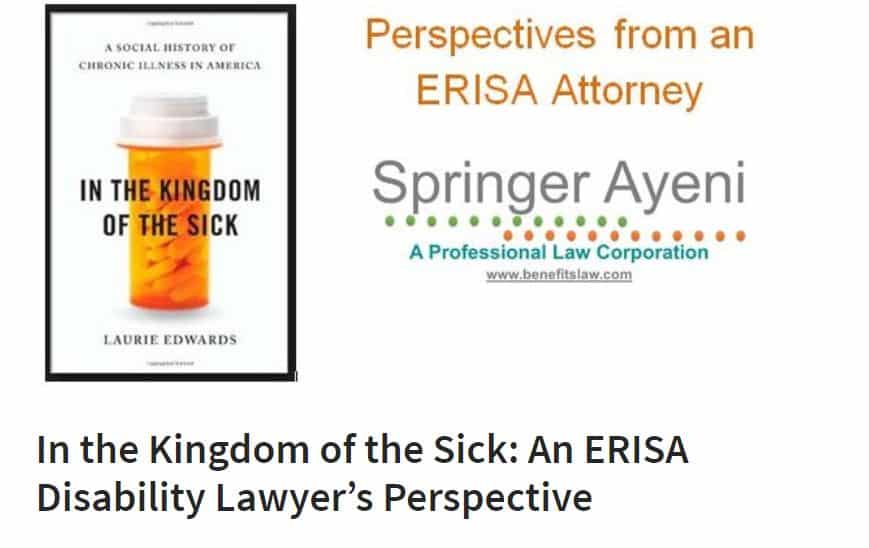
In the Kingdom of the Sick: An ERISA Disability Lawyer’s Perspective
In the Kingdom of the Sick: An ERISA Disability Lawyer’s Perspective
By Cassie Springer Ayeni
Springer Ayeni, A Professional Law Corporation
“‘Illness is the night-side of life, a more onerous citizenship. Everyone who is born holds dual citizenship, in the kingdom of the well and the kingdom of the sick . . . sooner or later each of us is obliged, at least for a spell, to identify ourselves as citizens of that other place.’” – In the Kingdom of the Sick at p. 4 (quoting Susan Sontag).
In Laurie Edwards’s book on chronic illness, In the Kingdom of the Sick: A Social History of Chronic Illness in America, she takes a broad approach to explain obstacles that people suffering from chronic illness currently encounter.
Chronic Illness Defined
Edwards identifies three primary traits in chronic illness: “the symptoms are invisible, symptoms and disease progression vary from person to person, and the disease progression and worsening or improvement of symptoms are impossible to predict.” (pp. 32-33.) She also notes that chronic illness is “treatable, not curable.” (p. 33.) Moreover, chronic illness is often accompanied by its life-altering companion, chronic pain, which can make it “excruciating to engage in physical activities, keep up with a regular work schedule, or even leave the house.” (p. 111.) And it is pervasive. According to Edwards, chronic illness, which includes heart disease, diabetes, cancer, and asthma, affects nearly 50% of the population. (p. 11.) An astounding 81% of hospital admissions are a result of chronic illness, as are 76% of all physician visits. (p. 11.)
Biases Against People with Chronic Illnesses
Edwards devotes much of In the Kingdom of the Sick to explaining the biases that those living with chronic illness encounter, both from an historical perspective and in the modern medical era. For example, Edwards notes that where conditions lack a cure, which is one of the inherent traits of chronic illness, “blaming the patient often follows suit.” (p. 6.) This bias of skepticism leads to potentially devastating consequences: “45 percent of patients with autoimmune disease were labeled as chronic complainers early in their diagnostic journeys, with the resulting delay in diagnosis often leading to organ damage from lack of appropriate treatment.” (p. 78.) In my experience representing ERISA disability claimants for the past 15 years, this inclination towards disbelief extends to the disability insurance context as well, where before a concrete diagnosis is reached insurers are inclined to deny a claim for disability benefits that are based on “self-reported symptoms,” and claimants who cannot seem to overcome their undiagnosed or misunderstood conditions are labeled as “malingerers.” Indeed, these biases have become so pervasive that the trend in long-term disability plans is to limit the duration of benefits payable for “self-reported conditions,” which is an ever-expanding group of non-fatal, but totally disabling conditions. Claimants are often left high and dry after receiving the maximum duration of benefits, but still prevented by their lifelong illnesses from returning to gainful employment.
Additionally, most ERISA disability plans are written with a 24-month or shorter maximum duration for “mental illness” conditions. However, as Edwards points out, people with chronic illness often have secondary depression and anxiety: “what if the person is anxious because he or she has been sick for weeks or months and physicians can’t seem to help? What if the person is depressed because he or she is at home sick, isolated from social events and falling behind in work?” (p. 107.) In my experience, many disability claims adjusters try to label the mental component as primary in order to justify limited payment duration, often ignoring the severity of the underlying physical condition.
Edwards also does an excellent job examining the historical and pervasive bias against illnesses that primarily strike women. She states: “throughout history, deeply ingrained ideas about women as unreliable narrators of their pain and symptoms, as weaker than men, and as histrionic or otherwise ‘emotional’ have had a profound impact on their ability to receive accurate diagnoses and appropriate care.” (p. 20.) Added to this inherent bias is the fact that until very recently, “[w]omen were navigating a hierarchical medical system dominated by males; women lacked knowledge and resources to advocate for their health.” (pp. 76-77.) Although times are changing as there are more women doctors and as studies are increasingly inclusive of women patients, women with chronic illnesses still encounter shades of these gender biases when diagnosed with conditions like chronic fatigue syndrome, where people “roll their eyes at [these patients] or come right out and tell [them] that CFS is a made up disease, a present-day hysteria, or that ‘everybody gets tired.’” (p. 103.)
Chronic Illness and ERISA Claimants
Edwards aptly notes that people with chronic illnesses are often not able to be accommodated by their employers, since the ability to maintain a regular work schedule is a job necessity. (p. 66.) A disability claim is the inevitable conclusion, where the claimants must then “prove” their disability to the insurer. However, the insurer may be skeptical because of the nature of chronic illness, where sufferers experience some days that are better than others. Edwards notes that such fluctuation is a hallmark of chronic illness: “The unpredictability of symptoms and their severity that sets chronic illness apart from certain physical disabilities can also make for ‘unreliable activists,’ individuals who might be able to run workshops or attend policy meetings one day and be bedridden the very next.” (p. 53.) The chronically ill ERISA claimant may encounter the same culture of skepticism in the insurance context that she likely already experienced when seeking treatment for what ultimately became a disabling condition. And this culture of disbelief extends to the health benefit context as well. Edwards poignantly recounts her own experience with chronic illness, stating “I am grateful for the excellent health insurance that I work incredibly hard to provide for my family, and even with that, there are always letters to write, explanations to offer, and battles to wage to convince the people in charge of approving claims that preventative care is truly medically necessary.” (p. 193.)
Skepticism in LTD benefit applications couples with the shame that many chronically ill patients experience in admitting disability to begin with. Edward quotes the experience of one woman who had to apply for Social Security Disability Insurance, which is often a requirement of ERISA LTD applicants: “‘I’m depressed about it because I prefer to live in denial that this is going to be a long-lasting or permanent condition. And I’m embarrassed because even though rationally I know SSDI is an insurance policy that I paid into since I got my first job at age fourteen, it feels like asking for a handout. Like it’s trying to go on welfare.’” (p. 55.)
And still another obstacle faced by many ERISA LTD applicants who are chronically ill is the shock of surveillance that captures “clustering” activities to periods of increased energy, which often then results of days of bed rest to make up for the exertion. Edwards notes that such behavior is a pain management technique rather than an indication of sustained energy, and details that chronically ill patients must engage in extensive planning ahead of time before engaging in everyday routines. (p. 103.)
A Validating Resource for Patients
Overall, In the Kingdom of the Sick is an excellent resource for people suffering from chronic illnesses to obtain comfort that their experiences of disbelief, bias, and isolation are not unique. However, because chronic illness is such an extensive topic, at times the book is painted in too-broad strokes. Edwards tries too hard to lump all chronic illnesses together, such as AIDS, CFIDS, and cancer, to draw the tenuous analogy that people are biased universally against those with chronic illness. The diseases and the movements behind the diseases may have some links, but are also very distinct, and each disease has its own social bias to overcome to generate more attention and funding.
In this lumping together, Edwards also misses the distinguishing factor in chronic pain conditions – most are not inherently fatal. She criticizes that the NIH spends 96% less money on chronic pain research than on cancer, cardiovascular disease, and diabetes combined, but these are all potentially life-threatening whereas chronic pain is perceived as more manageable.
Nevertheless, I would certainly recommend that my clients who are suffering from debilitating chronic illnesses read In the Kingdom of the Sick to understand the historical context of chronic illness and to understand the legitimacy of their own experiences and feelings surrounding their illnesses. I would also recommend that attorneys and doctors alike who are interested in being more compassionate caretakers of their clients and patients read this book. And, in a dream world, every insurance claims adjuster would read it too before making assumptions tinged with societal bias.
Cassie Springer Ayeni is the President and Founder of Springer Ayeni, A Professional Law Corporation, in Oakland, CA, where she focuses on ERISA disability and life insurance cases. She can be reached atcassie@benefitslaw.com or www.benefitslaw.com
Read More
Medical Professionals Who Have Disabilities: Why I Like to Help
By Cassie Springer Ayeni
I’ve developed a bit of a niche within my specialization of employee benefits (ERISA) law: I have helped numerous medical professionals secure their partial or complete disability benefits. My clients have been OBGYNs, family medicine practitioners, physical therapists, PICU M.D.s, gastroenterologists, specialized nurses, and more. I wonder: do I gravitate to them or do they gravitate to me?
I’ve always been a money saver, and to further that goal I started working during summers and after school when I was 13 years old. One of my favorite teen jobs was in the file room of my father’s medical office. I would take slips of dictation and put them into the right patient’s file, skimming the details and, without knowing it, becoming familiar with medical terminology and the fascinating process of diagnosis. I loved reading the symptoms, findings, and conclusion that came from every interaction and examination. I got a lot of paper cuts, but I also learned early lessons in medical analysis and interpretation.
My father is one of a dying breed in the world of medicine: a jack of all trades. He’s a family practitioner, and in the 1970s he even used to deliver babies. He performs and assists on surgeries, sees people of all ages, and is loved by his patients. I am the middle child of the 6 he fathered, and he once told me he thought I would take over his practice someday. But I excelled in writing, not chemistry, and my passion for analysis fell to the pages of Jane Austen and later Supreme Court cases, not to Gray’s Anatomy.
Yet here I am, 15 years into a career that involves reading and interpreting medical records every day, just as I did in my father’s office so many years ago. This time, though, I am reading these records for evidence in support of my client’s employee benefits disability claim against an insurer. I have read through hundreds of thousands of pages of medical records in my career, MRIs, CT Scans, labs and more, figuring out medical shorthand along the way, to make arguments to insurance companies and courts about why the medical evidence demonstrates a lack of work capacity.
Maybe it’s this familiarity with the tools of the trade that has resulted in a plethora of medical professionals as clients: I respect their craft and understand the tip of the iceberg, so I am particularly eager to help these clients out when a disability causes them to cut back their duties or stop working altogether. Whatever the reason, I certainly enjoy representing doctors and nurses, and I feel so fulfilled when one of my medical professional clients recommends a colleague connected to her/him. And by the way, my father is 75 years old and still working nearly full-time as a physician. Life Goals.
Cassie Springer Ayeni is the President of Springer Ayeni, A Professional Law Corporation, in Oakland and San Jose, California. She focuses on representing people in ERISA disability and life insurance cases. She can be reached at cassie@benefitslaw.com or www.benefitslaw.com
Read More
Reforming Disability Claim Procedures Under ERISA
On Dec. 19, 2016, the U.S. Department of Labor published in the Federal Register sweeping reforms to the regulations it issues under Section 503 of the Employee Retirement Income Security Act, aimed at eliminating bias in the ERISA disability claims and review process.
Despite ERISA’s reputation as an erudite law affecting primarily pension plans, the DOL reports that, “An empirical study of ERISA employee benefits litigation from 2006 to 2010 concluded that cases involving long-term disability claims accounted for 64.5 percent of benefits litigation whereas lawsuits involving health care plans and pension plans accounted for only 14.4 percent and 9.3 percent, respectively.” (p. 3.) Hence the DOL’s decision to take aim at the regulations affecting disability plan administration, which is typically handled by insurance carriers.
The DOL noted “the economic incentive for insurance companies to deny otherwise valid claims and because plans are often able to secure a deferential standard of review in court.” (p. 8.) Although the DOL received commentary that disability claims administrators should not be subject to the same rigorous regulations issued under the Affordable Care Act to health plan administrators, “the department views enhancements in procedural safeguards and protections similar to those required for group health plans under the Affordable Care Act as being just as important, if not more important, in the case of claims for disability benefits.” (p. 10.) It noted the need for transparency and accountability in all claims handling. (p. 11.)
The department enhanced protections for disability plan participants in eight ways (pp. 11-12):
Increased independence and impartiality of the decision makers
Adverse decisions must fully explain the reasons for the denials and why evidence of the claimant was disagreed with
Notification to claimants of the right to obtain their claim file and other documents before a final decision is made and to present testimony and other evidence in support of their claim
Provision of an opportunity for claimants to respond to adverse medical opinions before a final decision is made
A guarantee that a claimant can proceed to litigation if the administrator fails to comply with the DOL regulations (stricter than “substantial compliance”)
A guarantee that a rescission of coverage triggers appeal rights under the regulations
Cultural and linguistically appropriate requirements for communications
A requirement that the notice of an adverse benefit determination on review must include a description of any applicable contractual limitations period and its expiration date (p. 54)
But perhaps the biggest protection is the first, requiring impartiality not just in claims decision makers, but also in vocational experts, medical consultants and in-house medical reviewers. (pp. 13-15.) And the DOL understood and took issue with the notion that impartiality could be achieved if the administrator, for example, hires a company who then hires the medical expert for review. It stated: “The text of the rule does not limit its scope to individuals that the plan directly hires. Rather, the rule’s coverage extends to individuals hired or compensated by third parties engaged by the plan with respect to claims.” (p. 15.) It cautioned that such a prohibition should not temper a court’s inquiry into the neutrality of the expert, noting the availability of discovery to probe such matters. (p. 16.)
The DOL further disabused the insurance practice of rejecting experts that would support an approval of benefits in favor or experts that would support denial as inappropriate “expert shopping.” (p. 20.) It found that “[r]equiring plans to explain the basis for disagreeing with experts whose advice the plan sought” should help that problem. (p. 20.) The department couched the requirement to explain disagreement with medical and vocational professionals in denying a claim “as a matter of basic fiduciary accountability.” (p. 22.)
Regarding Social Security disability awards, the department was careful to specify that although it does not expect administrators to defer to a favorable Social Security disability determination, “a more detailed justification would be required in a case where the U.S. Social Security Administration definitions were functionally equivalent to those under the plan.” (p. 25.) It refused, however, to adopt the “treating physician rule” present in Social Security decisions, where the administrator must defer to the opinion of the treating physician. (p. 25.)
The department vigorously defended its decision to allow claimants to review and rebut evidence that would be used to deny a claim. Commenters argued that claimants could provide an endless loop of evidence supporting a claim that the administrator would have to rebut endlessly as well. The DOL dismissed that argument as contrary to fiduciary obligations: “The fiduciary obligation to pay benefits in accordance with the terms of the plan does not require a fiduciary to endlessly rebut credible evidence supplied by a claimant that, if accepted, would be sufficient to justify granting the claim. In fact, an aggressive claims-processing practice of routinely rejecting or seeking to undermine credible evidence supplied by a claimant raises questions about whether a fiduciary, especially one operating under a conflict of interest, is violating the fiduciary’s loyalty obligation under ERISA to act solely in the interest of the plan’s participants and beneficiaries.” (p. 37.)
Controversially, the department approved a “tolling” of timelines for responding to claims and appeals where the claimant submits additional evidence for the administrator to consider. “In the department’s view, the current disability claims regulation ‘special circumstances’ provision permits the extension and tolling expressly added to the group health plan rule under the ACA claims and appeals final rule.” (p. 40.) It remains to be seen if this will deny claimants swift access to the courts or even allow a statute of limitations to expire while tolling is in place. See Heimeshoff v. Hartford Life & Accident Insurance Co., 134 S.Ct. 604, 611 (2013). Perhaps in anticipation of this conundrum, the department addressed the potential problem raised by the Heimeshoff decision where a statute of limitations could expire while a participant was engaging in the mandatory review process prescribed under ERISA Section 503. It stated:
First, Section 503 of ERISA requires that a plan afford a reasonable opportunity to any participant whose claim for benefits has been denied for a full and fair review of that decision by 53 an appropriate named fiduciary. The department does not believe that a claims procedure would satisfy the statutory requirement if the plan included a contractual limitations period that expired before the review was concluded …
A limitations period that expires before the conclusion of the plan’s internal appeals process on its face violates ERISA Section 503’s requirement of a full and fair review process. A process that effectively requires the claimant to forego the right to judicial review and thereby insulates the administrator from impartial judicial review falls far short of the statutory fairness standard and undermines the claims administrator’s incentives to decide claims correctly. (pp. 52-53.)
It further stated that a contractual limitations period that does not permit a lawsuit after the conclusion of an administrative appeal “is unenforceable.” (pp. 53-54.) In an effort to provide transparency, the department will now require administrators to state any contractual limitations period “including the date by which the claimant must bring a lawsuit” in a final adverse decision. (p. 53.)
However, the department did not provide much leeway for plan administrators to avoid litigation for failing to comply with the regulations. In fact, for the administrator to argue failure to exhaust administrative remedies despite noncompliance, the administrator’s failure to comply must be all of the following: “(1) de minimis; (2) nonprejudicial; (3) attributable to good cause or matters beyond the plan’s control; (4) in the context of an ongoing good-faith exchange of information; and (5) not reflective of a pattern or practice of noncompliance.” (p. 42.)
The department refused to provide a general rule on the level of deference an administrator would receive from a reviewing court, but did indicate that where the administrator’s noncompliance has resulted in a claim’s deemed exhaustion, the “legal effect of the definition may be that a court would conclude that de novo review is appropriate because of the regulation that determines as a matter of law that no fiduciary discretion was exercised in denying the claim.” (pp. 43-44.)
Read More