



Understanding Disability Insurance
When a serious illness or injury prevents you from working, the financial consequences can be overwhelming. That is why disability insurance exists: to protect your income when you cannot earn a paycheck due to your serious and chronic medical condition. For many people, this benefit is just as important as health insurance or life insurance, yet it is often overlooked until a crisis occurs because almost no one anticipates a life-altering disability interrupting their anticipated career trajectory.
This article explains what disability insurance is, the types of coverage available, what it costs, and why it matters for employees.
What Is Disability Insurance?
Disability insurance is a type of income protection that pays a portion of your earnings if you are unable to work due to a qualifying medical condition. Unlike health insurance, which covers medical bills, disability insurance provides monthly income replacement so you can continue paying for your life expenses, which may be much more than just housing, food, medical expenses, and essentials.
Types of ERISA Disability Insurance Coverage
If you work for a private employer that provides disability insurance benefits, there are two main categories of coverage: short-term and long-term. Short-term coverage usually lasts a few weeks or months, often bridging the gap while you recover from a temporary condition. Long-term coverage provides benefits for years, sometimes up to retirement age, if your disability prevents you from returning to work.
Employer-sponsored benefit plans often include long-term disability insurance, particularly for employees in the medical, legal, tech, and finance fields. For private employers (as opposed to those working for the government or religious institutions), plans are typically governed by ERISA, the federal law that regulates employee benefit programs. For those without access to an employer plan, private disability insurance can be purchased individually.
Disability Income Insurance
The term “disability income insurance” emphasizes what the policy provides: replacement of a portion of your lost wages. Policies commonly pay between 50% and 70% of your prior income, subject to caps (maximum benefits) and offsets for other income sources.
Your particular disability insurance policy usually has a “Schedule of Insurance” page near the front that outlines the percentage of pre-disability earnings covered, and maximum benefit, the minimum benefit after offsets, and the maximum duration. Other sections of the policy will itemize the offsets for “income from other sources,” which typically include any state disability benefits, Social Security Disability Income for you and your dependents, some Workers’ Compensation benefits, and perhaps several other types of income you may receive while disabled. You should read this section of the policy carefully before signing any kind of severance agreement, before taking a retirement distribution, or before earning any kind of income from another source.
Additionally, you should be careful not to sign any separation agreement that waives your right to ERISA (Employee Retirement Income Security Act) claims, because if you do you could waive your right to your ERISA Disability Insurance Claim(s). Rather, talk with your employer about carving out your ERISA disability claims from any separation agreement you may be asked to sign.
Incredibly, the Social Security Administration notes that one in four 20-year-olds today will experience a disabling condition before retirement age.1 While Social Security Disability Insurance is an important start, without supplemental ERISA disability insurance policies, many workers, especially those living in high cost of living areas, could not live on the SSDI benefit alone, which has a relatively low maximum monthly benefit. The ERISA disability policy provided by your employer should bridge the gap between the public benefit and a higher percentage of your pre-disability earnings.
Individual and Private Disability Insurance
While group coverage through an employer is common for most professionals, particularly those in medical, legal, financial, and tech, high income earners may choose to supplement their group (ERISA) policies with their own individual disability insurance. An individual policy offers portability (you keep it even if you change jobs) and customization of terms such as waiting periods, benefit periods, and definitions of disability.
Most major insurance companies offer options for applying for supplemental disability coverage so that you can protect more of your income than your ERISA disability plan may provide.2
If you are considering supplemental coverage, it is wise to request long-term disability insurance quotes from multiple carriers. This allows you to compare definitions of disability, benefit percentages, elimination periods, and exclusions.
Quotes also reveal how premiums differ depending on whether you choose a policy that defines disability in terms of your “own occupation” (unable to perform your current profession) versus “any occupation” (unable to perform any job for which you are reasonably qualified).
Because the definitions and terms vary widely, reviewing long term disability insurance quotes with the help of an attorney or trusted advisor ensures you understand what you are buying.
Insurance for Disability: Common Misconceptions
Many people assume that Social Security Disability Insurance or workers’ compensation will be enough to protect them. In reality, these programs are limited. SSDI requires that your condition be expected to last at least 12 months and prevent you from performing any substantial gainful activity.3 Moreover, Social Security benefits are subject to a rather low maximum monthly benefit that could be a fraction of what professionals are earning in high cost of living areas, such as in Northern California.
Workers’ compensation only applies if your disability is caused by your job, and benefits may be limited or disputed. ERISA or private disability insurance policies fill this gap by protecting you from illnesses or injuries unrelated to your occupation, and by providing a higher monthly benefit, and often with a less stringent definition of disability.
Why Disability Insurance Matters
Disability insurance is not about expecting the worst; it is about preparing for the unexpected.4 Illnesses such as cancer, multiple sclerosis, or heart disease, as well as injuries from accidents, can interrupt your expected career trajectory, causing you to leave the workforce much sooner than anticipated.
The reality is that income protection is one of the most important financial safeguards for individuals and families. Without it, even a short-term disability could drain savings, while a long-term condition could derail life and even retirement plans entirely.
Bringing It All Together
Disability insurance may not be a benefit most people think about until they need it, but it is essential to financial security. Whether you are evaluating long term disability insurance quotes, reviewing your employer’s group disability insurance coverage, or exploring private disability insurance as a supplement to your employer-sponsored ERISA plan, understanding your options is key.
At Springer Ayeni, we have guided professionals for more than two decades through the complexities of disability insurance coverage, from initial claims to appeals and litigation.
If you are unsure about what coverage you need—or if you are facing challenges with a claim—we are here to provide clarity, strategy, and compassionate advocacy.
References:
1 Social Security Fact Sheet. Social Security Administration.
https://www.ssa.gov/news/press/factsheets/basicfact-alt.pdf
2 Supplemental individual disability income insurance. (24 July, 2025). Guardian. https://www.guardianlife.com/disability-insurance/supplemental
3 Disability Evaluation Under Social Security. Social Security Administration. https://www.ssa.gov/disability/professionals/bluebook/general-info.htm
4 “Disability Can Strike Unexpectedly, So Be Prepared.” (2023, November 13). NASA Federal Credit Union. https://www.nasafcu.com/blog/detail/disability-can-strike unexpectedly-so-be-prepared
Read More
The ERISA Appeal Process
If your long-term disability claim has been denied, you are not alone. Insurance companies deny many legitimate claims, often leaving employees uncertain about what to do next. Fortunately, under the Employee Retirement Income Security Act of 1974 (ERISA), you have the right to challenge the denial. This process is called an ERISA appeal process or a Request for Review, and understanding how an ERISA appeal process works is crucial to protecting your benefits.
This guide explains the ERISA appeal process in detail: how it works, what regulations govern it, what evidence you might need, and why careful preparation and the help of experienced attorneys can make or break your case.
Why the ERISA Appeals Process Matters
ERISA governs most employer-sponsored benefit plans, including long-term disability insurance. If your claim was denied, ERISA requires that you first pursue an internal appeal with the insurance company before you can file a lawsuit in federal court. This requirement is known as “exhausting administrative remedies” and ERISA requires that you receive a “full and fair review” of your ERISA appeal.1
Your ERISA appeal is not merely a requirement. It is often your last chance to add evidence to the record. Federal courts reviewing ERISA cases generally limit their review to the evidence submitted during the claim and appeal stages. If you fail to submit key medical records, vocational reports, or supporting statements now, you may not be able to use them later. The U.S. Department of Labor explains these rules in its Disability Claims Procedure Regulations, which set specific requirements for insurers and protections for employees.2
Understanding ERISA Appeals Regulations
Under ERISA’s most up-to-date regulations, ERISA plan administrators (often long-term disability insurance companies) must:
- Give you a clear explanation of why your claim was denied.
- Provide access to all documents, records, and guidelines relevant to your claim.
- Must not rely on new evidence in the appeal without giving you a chance to respond.
- Decide an appeal within a set timeframe, usually 45 days, with one possible 45-day extension.
You can review the regulatory framework at 29 C.F.R. § 2560.503-1, available at no cost through Cornell Law School’s Legal Information Institute.3
The timelines and disclosure requirements in the ERISA regulations are not suggestions; they are binding obligations on insurance administrators of ERISA disability plans.
Four Critical Steps to Perfect Your ERISA Appeal
To achieve success in an ERISA appeal, you must request and analyze the claim file following receiving the denial letter, prepare supporting evidence in support of your appeal, and submit the appeal before the 180-day deadline, as outlined in these steps:
1. Review the Denial Letter
The first step in the ERISA appeal process is carefully reviewing the denial letter. This letter must explain:
- The specific reasons for denial.
- The policy provisions relied upon.
- What additional information, if any, is needed.
- How and when you can file an appeal.4
Denial letters often cite lack of “objective evidence,” conflicting medical opinions, or surveillance reports. Understanding the insurer’s reasoning will help you target your appeal effectively.
2. Request the Claim File
Before preparing your appeal, request a complete copy of your claim file. This is your right under ERISA. The file should include medical reviews, credentials of the medical reviewers, audio files of any recorded phone conversations, vocational assessments, surveillance records, all medical records obtained, all correspondence generated or received by the insurance company during your entire claim, and internal notes made by the insurance company.
The best practice is to list each of the items you are requesting in your claim file request, rather than just stating that you are requesting the “claim file.” In case you are told that audio recordings will not be disclosed, note that The Employee Benefits Security Administration specifically informed Cassie Springer Ayeni that audio recordings are relevant to a claim file and must be disclosed.5
3. Strengthen Your Medical Evidence
The most critical part of your appeal is the medical documentation. Insurers often deny claims by arguing that the evidence does not support functional limitations. To counter this, you should provide anything helpful and relevant to your case, including:
- Updated medical records since the original denial, or any medical evidence not included in the claim file.
- Detailed statements from your treating physicians.
- Detailed statements from you setting forth your vocational and medical history.
- Detailed statements from friends, family, and colleagues about their observations of your limitations.
- Diagnostic tests, imaging, or lab results when available.
- Additional testing of functional capacity, cognitive limitations, etc.
- Explanations of why symptoms such as fatigue, pain, or cognitive impairment prevent reliable work performance.
- Photo or video evidence, where applicable.
- Reliable sources of evidence explaining your condition and its limitations.
For example, the Mayo Clinic provides in-depth information on conditions like multiple sclerosis, lupus, and chronic fatigue syndrome—illnesses that often form the basis of ERISA disability claims. Referencing credible medical sources can strengthen your appeal.
4. Address Vocational Demands
Disability under most policies is defined in terms of your ability to perform your “own occupation” or, later, “any occupation,” subject to the specific terms of your particular disability insurance policy. That means your appeal should include vocational evidence showing how your limitations prevent you from performing the material and substantial duties of your occupation, not just your job for your particular employer.
When submitting your appeal, be sure to submit a detailed job description, as well as other evidence for how your occupation may be performed in the national economy, such as descriptions from the Department of Labor Occupational Keyword Search Database6 or a vocational report. Demonstrating how your specific job demands conflict with your medical restrictions can be critical in explaining why you are disabled from your particular occupation.
Writing an ERISA Appeal Letter
An effective ERISA appeal letter is more than a simple request for reconsideration. It should:
- Identify errors or gaps in the denial letter.
- Reference the policy language and ERISA regulations in play.
- Attach all supporting evidence.
- Argue clearly why you meet the policy’s definition of disability.
- Cite to relevant legal authority analogous to your particular facts.
Because this letter forms the backbone of any future litigation, many claimants seek legal counsel to ensure it is thorough.
Timelines and Deadlines
Under ERISA claims procedures, you usually have 180 days from the date of the denial letter to file your appeal. Missing this deadline can permanently forfeit your right to the claim altogether.
Once you submit the appeal, the insurer has 45 days to make a decision, with one possible 45-day extension if they provide valid reasons. These deadlines are set by federal regulation and can be enforced in court if insurers fail to adhere to the strict deadlines.
In one of Springer Ayeni’s victories, the court held that the mandatory ERISA deadlines are bright lines, and strict adherence is required. Hasten v. Prudential, 470 F. Supp. 3d 1076 (N.D. Cal. 2020).7 There, the court wrote: “It is uncontested that the Defendant failed to decide Plaintiff’s claim within the time frames defined in the pertinent regulations. In addition, Defendant failed to follow procedures for properly requesting deadline extensions. Thus, the Court finds that Defendant did not strictly adhere to the claim handling process as required under the applicable ERISA regulations.”
Common Tactics by Insurers
During the ERISA claims administration process, at either the claims or appeals stage, insurers may:
- Send you for an “independent medical examination” by a doctor they choose.
- Conduct video surveillance.
- Rely on in-house physicians who review records without ever examining you.
- Mischaracterize or selectively quote your medical records.
Recognizing these tactics can help you and your attorney prepare stronger responses. It is important that an effective appeal address directly any flawed interpretation of your medical information, or point out where an insurer or medical reviewer may have “cherry picked” evidence to support a denial.
After the Appeal: Litigation
If your appeal is denied, your next step may be a lawsuit in federal court. At that stage, the judge will usually review only the “administrative record” or “claim file” created during your claim and appeal. That is why building a complete record during the ERISA claims and appeal process is so vital.
Why Legal Representation Is Critical
While ERISA was intended to protect employees, the reality is that the law often favors insurers. Courts may give significant deference to the insurance company’s decision unless you can prove it was arbitrary and capricious, unless the standard of review is de novo. That is why the appeal is the most important stage of the process for evidence building.
Experienced ERISA attorneys know how to frame medical and vocational evidence, cite applicable regulations and case law, and preserve issues for litigation. Without that expertise, claimants may not even be able to secure legal representation to assist with litigation. In other words, it is critical to hire experienced ERISA counsel as soon as you receive a denial letter.
Bringing It All Together
The ERISA appeal process can feel overwhelming, especially when you are already dealing with a serious medical condition. But it is also your opportunity to strengthen your claim by submitting a robust appeal complete with thorough medical evidence. By carefully reviewing your denial, gathering strong evidence, and submitting a detailed ERISA appeal letter, you can significantly increase your chances of success. It is best to do this with an ERISA lawyer at your side to handle it for you and relieve you of the significant stress this process can create.
At Springer Ayeni, we have been guiding clients through ERISA claims appeals for more than two decades. We understand the law, we know the tactics insurers use, and we are committed to fighting for the benefits our clients deserve. If your claim has been denied, we are here to help you take the next step with clarity and confidence.
1, 2, 3, 4 3 29 CFR Sec. 2560.503-1. Cornell Law School Legal Information Institute. https://www.law.cornell.edu/cfr/text/29/2560.503-1
5 Information Letter 06-14-2021. U.S. Department of Labor, Employee Benefits Security Administration. https://www.dol.gov/agencies/ebsa/about-ebsa/our-activities/resource center/information-letters/06-14-2021
6 O*NET OnLine. U.S. Department of Labor, Employment & Training Administration. https://www.onetonline.org/
7 Hasten v. Prudential, 470 F. Supp. 3d 1076 (N.D. Cal. 2020). FindLaw. https://caselaw.findlaw.com/court/us-dis-crt-n-d-cal/2075810.html.
Read More
I’m a Physician with a Disability—What Can I Do to Protect Myself?
As a physician, you’re trained to solve complex problems under pressure. You have worked hard for your career, and probably never expected to have to stop working due to a disability. Perhaps you applied on your own for those benefits and the insurance carrier denied your claim, or perhaps you’re beginning the process of applying for long-term disability insurance benefits. What can cause highly educated medical professionals to lose their long-term disability appeals?
It’s not a lack of intelligence. And it’s definitely not because you’re “not really disabled.”
In my work representing physicians and other high-income professionals, I’ve seen a frustrating pattern: doctors who rightfully file for disability benefits are denied just as frequently (and sometimes more so) as people who are not trained in medicine.
Here’s what’s going wrong, and how you can protect your livelihood and your future.
- Doctors are often treated on an informal basis by their colleagues
Any professional with a large network of trusted colleagues will turn to them first when something in their field goes wrong. That’s a given, and I get it. My father was a general practitioner from 1969 until 2021, when he passed away, and he was my first, and often only, phone call when I or my family had a medical concern. However, these initial, informal phone calls and diagnoses don’t make it into your medical records. So while you may have a months- or years-long history of seeking medical advice for your ailment, the medical records may look as though you just started treatment for a condition that has now become disabling. My first task with any of my clients in the medical field is to request their complete relevant medical records, so that I can ascertain how supported their disability is within the records that the insurer will review. And if those records are incomplete or sparse, I develop a strategy, through declarations, letters, or any other means, to make sure that the true course of treatment is documented in the long-term disability claim file.
- Insurers may use narrow definitions of “Disabled” for doctors
If you’re a surgeon who can’t operate anymore, that may seem clearly disabling to you. But your policy might say otherwise—especially if it’s a group policy through your hospital or medical group.
Many doctors are shocked to learn that their policy allows the insurer to deny benefits if they can do any work in a related field, such as consulting or teaching.
What to do: Get a copy of your full policy—not just the summary. A legal review by Springer Ayeni can help uncover how your “own occupation” is actually defined.
- Doctors may think it’s better to scale back to part-time rather than filing a disability benefit claim
In my experience, physicians and other professionals who have dedicated their lives to developing their expertise through education and practice, are incredibly determined to hang onto even part of their work rather than file a claim under disability insurance policies. Why? Because you have worked for your entire life to become a physician, and you may have even set that personal goal when you were just a child. My father never retired as a physician, and even when he became frail and sick, he kept working, forsaking all else, until shortly before he passed. For those of us who truly enjoy helping others in our profession, we may not even contemplate retirement, let alone leaving the practice much earlier than expected due to a disability.
Unfortunately, long-term disability insurers often operate under what I have dubbed the “hit by a bus theory,” where one day you are fully capable of performing your job without limitation, then you get “hit by a bus,” and the next day you are disabled. Most disabilities are not so straightforward, and many physicians continue working as long as they can with progressive disabilities,.
If you have strived in your profession for years and years, then your medical condition causes you to lose some capacity, you might start by scaling back your hours, or switching to more administrative tasks. Before making this kind of career move, please give me a call at 510-926-6768, so I can discuss the strategy of whether you might qualify for long-term disability benefits, and what the impact of switching job duties or reducing hours might be on an eventual disability claim.
What to do: Call me to discuss your disability and the terms of your benefit plan as soon as possible so that you can develop a strategy for whether, and how, you might either scale back your duties, file for disability benefits to replace your lost income, or both. Ironically, disability insurers often scrutinize partial disability claims harder than total disability claims, seeming to punish those who have tried heroically to keep working despite disabling limitations. I am here to help and advise, and I encourage you to let me help you make an informed decision about reducing your hours or filing a disability claim.
- Medical Records or Treating Physician Forms Alone Usually Aren’t Enough
Insurers don’t just want to know your diagnosis. They want to see how your condition limits your ability to perform your specific job duties. In the ultimate “gotcha,” however, insurance forms for treating physicians to fill out either don’t ask the right question (“how”) or don’t leave enough room for your doctor to answer that question thoroughly. Stating an ICD Code and a condition, like “long-COVID,” “Parkinson’s Disease,” “Mild Cognitive Disorder,” “Major Depressive Disorder,” or “Migraine,” etc., is insufficient to prevail on a claim for disability benefits. You and your doctor need to explain how your condition affects your ability to specific tasks in your practice, such as stand during rounds, hold your arms in the correct position during surgery, respond adequately to emergencies, work a nightshift or be on-call, or manage a high-stress practice.
What I suggest: Work with your treating doctor to create a detailed functional report—not just a chart note, by writing down a list of what specific job duties are affected by your disability, and going over that list with your treating physician. It’s best if your medical records can be as detailed as possible about what you are unable to do at work. Also, the boxes on insurance forms are not a limitation! Put in an asterisk and attach a supplemental page or 2 to submit as much helpful information as possible.
- Doctors Are Prime Targets for Surveillance
High-income professionals like doctors are often watched, because they are expensive claims for the insurer to pay. A short video of you walking, driving a distance longer than your restrictions permit, shopping in a store, or attending your child’s sports game can be twisted to argue you’re not truly disabled.
What to do: Make sure all of your social media settings are set to “private.” Be mindful of what you do in public and what your restrictions and limitations are. Be honest in disclosing your actual activities on forms. For example, if your physician has recommended exercise to improve your disabling conditions, make sure you state on your application or update forms what you do and why it was prescribed by your doctor. If benefits have been denied, be sure to request and review all surveillance footage so that you can include context for what was actually happening on that day. Judges ultimately appreciate context, and understand that there may be anomalous events that do not necessarily mean that you can return to the full-time practice of medicine. While insurers may be looking for a “gotcha,” have faith that most judges are wise enough to see the big picture.
- ERISA is brutally technical
The ERISA process has strict rules. You often get only one appeal to submit your evidence, and it must be submitted by a specific date or you lose your right to the claim. Moreover, if you miss including key documents, you may not have the chance to get that evidence in front of the court if you later go to court.
What to do: Don’t wait until after your appeal is denied to consult a lawyer. The best time to get legal help is before you submit your appeal—when there’s still time to shape the record. Reach out to me at www.benefitslaw.com or 510-926-6768 and I would be happy to discuss your specific issue with you in more detail.
Read More
The Elephant in the Room: Can AI Really Handle Your ERISA Disability Claim and Appeal?
Why Turning to a Bot for Legal Advice Could Hurt Your Claim—And What You Deserve Instead
Let’s be honest: more and more people are asking AI tools like ChatGPT or Google’s Gemini how to appeal a denied disability claim before they ever think of calling a lawyer.
I get it. AI is fast. It’s available 24/7. It doesn’t require talking with a live person about the difficult details of your health. And, of course, AI is free or low-cost.
But when your financial stability and health are on the line, you need to know the full truth: AI is not a substitute for experienced legal counsel. In fact, trusting AI blindly could do more harm than good.
As someone who has spent 23 years representing clients in ERISA disability cases, I’m not here to bash technology. There is much to gain from the efficiency of evolving technology and I am certainly not advocating AI abstinence. I am here, however, to lay out the risks, differences, and reasons why having a compassionate, strategic, and knowledgeable attorney matters for something as critical to your financial health as your long-term disability benefits.
Why People Turn to AI—and Where It Falls Short
If you type into ChatGPT:
“How do I appeal a denied ERISA disability claim?”
You’ll probably get something like this:
“Request your claim file. Review the denial letter. Submit additional medical evidence. Write an appeal within 180 days.” You might even get general “advice” about including medical records and statements in support of your appeal. However, even AI knows its own limitations. A common Bot disclaimer goes something like this:
“Generative AI features are not intended for professional advice. Do not use generative AI features to seek or provide legal, medical, financial, or other kinds of professional advice or any opinions, judgments, or recommendations without conducting your own independent consultation or research. Generative AI features cannot replace advice provided by a qualified professional and do not form any such relationship (e.g., attorney-client relationship).” (https://www.adobe.com/legal/licenses-terms/adobe-gen-ai-user-guidelines.html)
Even tech giants know that the disclaimer is necessary because AI advice is not strategic, not confidential, not detailed, and, in fact, is dangerously simplistic.
For example, AI does not, and cannot, analyze whether your plan’s language requires a de novo or abuse of discretion standard of review in court; whether the facts of your case meet the definition of disability under your plan language; whether the insurer has disclosed all required information in its claim file; whether there is evidence of biased claims handling in your file; whether the insurer has calculated offsets accurately in your case; what evidence in the claim file needs to be rebutted in an appeal; what the likelihood of settlement and possible settlement amount in litigation might be. The list goes on and on. These are the kinds of distinctions that change the outcome of a case—and they’re not in an AI’s toolbox.
The bottom line: AI gives you non-confidential general advice. Springer Ayeni gives you a legal strategy based on decades of experience handling ERISA long-term disability cases.
AI “Hallucinations” and Fake Law: A Dangerous Trend
AI tools are known for hallucinating legal citations—that is, making up case law that sounds real but isn’t. See https://hai.stanford.edu/news/ai-trial-legal-models-hallucinate-1-out-6-or-more-benchmarking-queries I’ve read up on examples of how AI will generate completely fictitious case references and quotes from decisions that don’t exist. This isn’t just sloppy, it’s dangerous.
First, if you submit an appeal letter to an insurer or judge citing bogus cases, you undermine your credibility. Second, insisting that there are cases in your favor when you reach out to an attorney, when those cases are entirely fictious (unbeknownst to you), will make an attorney hesitant to offer to represent you. Attorneys and their clients should be on the same team at all times. Most importantly, you won’t even know when AI has done you dirty with a fictitious citation, because it often sounds right and the wrong cases are mixed right in with actual cases.
The bottom line: Legal writing is not just writing. It’s advocacy, precision, and ethics. AI is still a baby in the world of law, and cannot be trusted to do actual legal research.
AI Is NOT Confidential, and that Can Put You at Risk
AI is not a lawyer. It doesn’t form an attorney-client relationship, as all of the tech User Guidelines state. That means:
- There is no legal confidentiality. What you input may be stored, analyzed, or even discoverable later.
- You might waive privilege by sharing facts about your medical condition, employment, or insurer. Moreover, AI remembers your input from search to search, so even if you don’t share all the facts in one session, it may know a lot more about you, your condition, your family, your history, your dreams, and your goals from all of the data you have input in previous searches.
- There is no duty of loyalty. AI doesn’t protect your interests—it just completes a task. For example, when Chat GPT conversations are shared, Google produces those conversations as “results” upon a simple search. See https://cybernews.com/ai-news/chatgpt-shared-links-privacy-leak/
As an attorney, I never input confidential client information into AI platforms. Doing so risks ethical breaches and the security of your case. Some lawyers are misusing AI and unknowingly exposing clients. That’s not how I work.
If I use AI at all, it’s only for mundane administrative tasks—not for case strategy, legal analysis, or communication.
The bottom line: Your trust is sacred. And your privacy is non-negotiable. AI will not protect you and advocate for you like a good attorney will.
A Real Appeal Tells the Real Story—Not Just the Medical One
An AI might focus only on lab results and doctor notes. But I know that winning a disability appeal requires telling your whole story, not just summarizing medical visits. It also requires understanding the law and how it applies to the facts of your case, and being able to spot and rebut flaws in the insurer’s claims handling and medical reviews.
I listen for and translate the truths that often don’t make it into a medical file, like how your fatigue crashes your productivity by noon, or how your brain fog makes multi-step tasks impossible not just at work but in your everyday life, or how your anxiety prevents you from completing your tasks efficiently, or even how you have good days and bad days, requiring you to rest for days if you have over-exerted yourself on a good day.
I draw out the details of your daily life, your work history, and your limitations, and I explain them clearly and persuasively to the insurance company. This isn’t something a chatbot can do. It takes time, training, empathy, experience, and sound judgment.
The bottom line: I’m not just reviewing records. I’m building your narrative, filling gaps in the file, rebutting arguments, and fighting for your future.
AI Can’t Show Up for You. I Will.
Some pundits say AI will replace lawyers. I do think that technology can make lawyers more efficient at administrative tasks that take away from time spent on actual cases. However, the best lawyers, those who listen, advocate, strategize, work as a team with their client, and ultimately are successful in cases, cannot ever be replaced by a bot. Technology will evolve, but compassion, reputation, and results still matter.
When you retain me, you’re not getting a script. You’re getting:
- 23 years of ERISA disability experience
- Strategic, circuit-specific legal knowledge
- A reputation for success and tenacity among colleagues, insurers, and opposing counsel
- A teammate who sees you as more than a claim number
- A fierce advocate who will not ignore you or reduce you to a piece of datum that will influence future actions
The bottom line: You deserve someone who understands not just the law, but the weight of what’s at stake. You deserve someone who knows how to get results and treats you with dignity along the way.
Final Word: Don’t Trust a Bot with Your Livelihood
AI has its place, but not as your attorney. Not when your disability benefits, your financial survival, and your mental and physical health are on the line.
Before you go down a rabbit hole of chatbot answers, talk to someone who’s been through this hundreds of times, someone who won’t hallucinate law, who respects your privacy, and who knows how to win an appeal, not just write about it.
Contact Springer Ayeni today. Let’s protect what matters most—your income, your dignity, your future.
Springer Ayeni: Compassion. Reputation. Results.
www.benefitslaw.com
ERISA Basic Virtual Conference by ABA Joint Committee
Please join me, my program co-chairs, panelists, and participants at the American Bar Association Joint Committee on Employee Benefits’ “ERISA Basics” Virtual Conference that will take place from December 7-10, 2020! This year covers series of discussions that span Business Law, Health Law, Labor and Employment Law, Real Property, Trust and Estate Law, Taxation, Tort Trial and Insurance Practice.
To sign up: https://www.americanbar.org/events-cle/mtg/web/403621552/
Or contact: Cassie Springer Ayeni, President of Springer Ayeni, A Professional Law Corporation @www.benefitslaw.com
#ABA #JCEB #ERISA #Employeedisabilitybenefits #disablity #ERISAlawyer #Superlawyer #Disabilityclaims #Disabilityappeals #Longtermdisability #ERISAlitigator #ERISAbayarea #Disabilitylawyer #Employeebenefitslawyer #ERISAlawfirm #SpringerAyeni #benefitslaw
Read More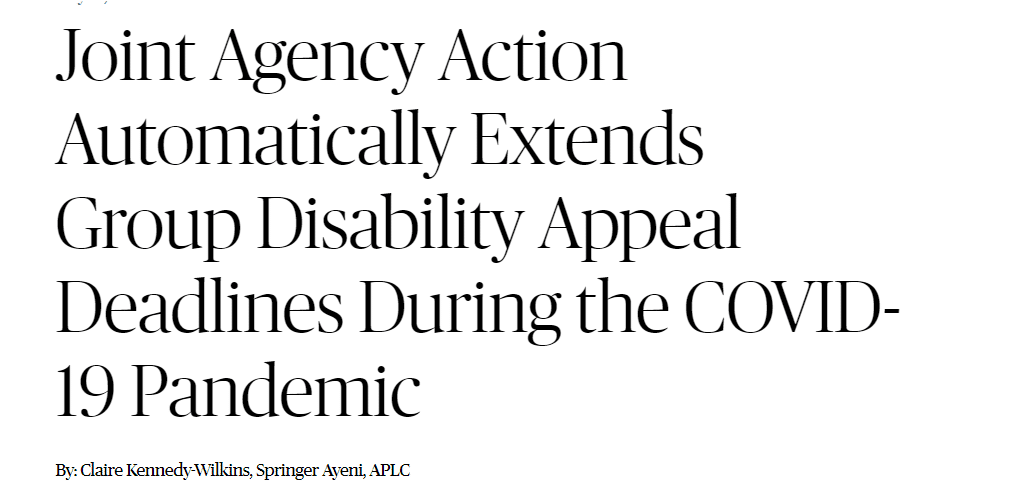
Joint Agency Rule Extend Disability Appeal Deadline in COVID
Congratulations to my co-worker, Claire Kennedy-Wilkins for her thoughtful and insightful article
“Joint Agency Action Automatically Extends Group Disability Appeal Deadlines
During the COVID-19 Pandemic.” In these times, it is great to know that EBSA
and DOL are aware of the added burden on disability plan participants to gather
information for appeals of denied claims and have acted in the interest of
these participants.
#Coviddisability#ABA#erisalawyer#erisabayarea#ERISA#springerayeni#disabilityappeals
https://www.americanbar.org/groups/labor_law/publications/ebc_news_archive/issue-spring-2020/joint-agency-action/
ERISA Basics National Institute 6-Part Webinar Series
June 15th – 17th 2020, I will be speaking on two Employee Benefits Claims panels at the American Bar Association Joint Committee on Employee Benefits sponsored – ERISA Basics National Institute 6-Part Webinar Series. On the panels, I will present: 1) Statutory Overview and 2) Benefit Claims: Administrative Procedures & Litigation. The great news is that – it is virtual! Now you can join in without the burden of travel! #silverlinings. I look forward to the discussions, questions, and sharing of insights/ideas.
For more, see event details: https://www.americanbar.org/events-cle/mtg/web/394126606/
Or contact: Cassie Springer Ayeni, President of Springer Ayeni, A Professional Law Corporation @ www.benefitslaw.com
#JCEB #EBC #ABA #ERISA #Employeedisabilitybenefits #disablity #ERISAlawyer #Superlawyer #Disabilityclaims #Disabilityappeals #Longtermdisability #ERISAlitigator #ERISAbayarea #Disabilitylawyer #Employeebenefitslawyer #ERISAlawfirm #SpringerAyeni #benefitslaw #presenter

Cassie Springer Ayeni Named SuperLawyer 6 Years in a Row
For the 6th consecutive year, Cassie Springer Ayeni has been named a SuperLawyers Top 50 Women Attorney for Northern California, and a Top 100 Attorney for the 5th consecutive year. She has been named to the SuperLawyers list for her expertise in employee benefits for 8 consecutive years.
Read More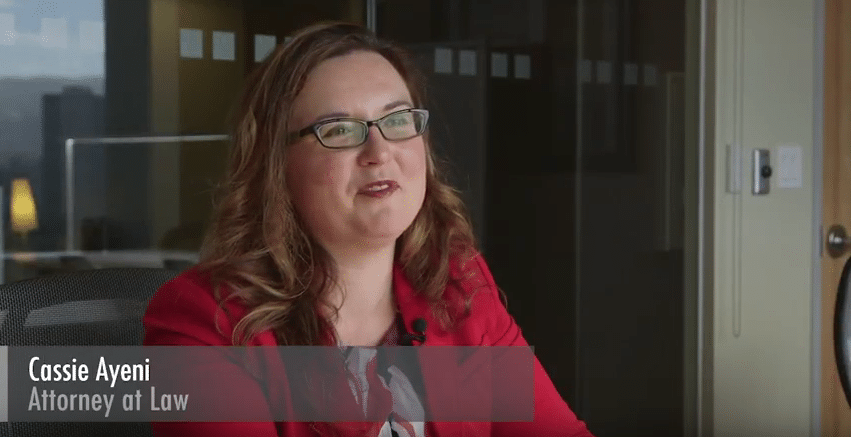
Incoming chair message to Employee Benefits Committee
So much has happened in these few months since I wrote this message to the Employee Benefits Committee as one of its incoming co-chairs. Since then, we had a successful midwinter meeting in Rancho Mirage, but none of us knew that would likely be our last travel occasion for the foreseeable future. Here’s a blast from the near past, which feels like a lifetime ago:
Read More
Here’s a blast from the near past, which feels like a lifetime ago
So much has happened in these few months since I wrote this message to the Employee Benefits Committee as one of its incoming co-chairs. Since then, we had a successful midwinter meeting in Rancho Mirage, but none of us knew that would likely be our last travel occasion for the foreseeable future. Here’s a blast from the near past, which feels like a lifetime ago:
Read More